
Your Home Away From Home


To start, we’d recommend climbing up to Cullera Castle, a 10th century fortress that is open to visitors and home to the Municipal History and Archaeology Museum. The castle is also used as the venue for all sorts of cultural events. Next to the castle is La Mare de Deu del Castell Sanctuary (also known as La Virgen de la Encarnación Sanctuary), a beautiful 19th century place of worship that it’s worth taking your time to look around.

Next, make your way to Alt del Fort and the Carlist Wall, the ruins of a fort that grants incredible views. And then there’s Marenyet Tower, a 16th century structure that used to monitor the comings and goings of the sea waters.

Once you’ve visited these monuments with a town and sea view, it’s time to venture to L’Albufera Natural Park, El Estany Lake and Bassa de Sant Llorenç, beautiful wetland landscapes that make the perfect birding spot. You also won’t want to miss the area around the mouth of the River Júcar where you can do some fishing or climb aboard a boat to take a cruise.

Dragut, the Turkish pirate who sacked the city of Cullera
Piracy was a constant throughout the 16th century. From the middle of the century, attacks and subsequent looting by the Turks and Berbers on various points of our geography were frequent. And on May 25, 1550, it was Cullera's turn at the hands of the Turkish pirate Dragut, Barbarossa's lieutenant. In the pirate cave-museum of Cullera we can visit a unique exhibition on piracy in the 16th century.

Church of the Saints Juanes of Cullera
This temple was built after the Christian conquest . Jaume I carried out the construction process of this church. In this way a change of sociological, economic and religious orientation arose. In this way Christianity replaced Islam and, consequently, churches replaced mosques. The current church dedicated to the Saints Juanes dates from the year 1692. It was built on the foundations or remains of a previous church dating from between the 13th and 14th centuries.
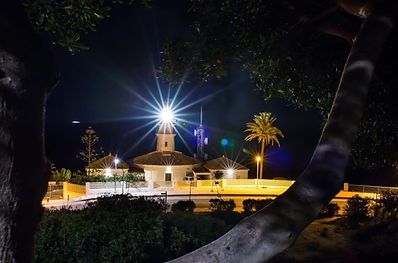
Cullera Lighthouse
The Cullera Lighthouse was built in the place known as Punta del Faro. It is one of the two remaining examples on the coast of the province of Valencia. It is a circular building, in the centre of which rises the ashlar tower, with a truncated cone section and sixteen metres high. It has three exterior openings. Its lamp was lit for the first time on 1 August 1858. Its focal plane rises 27.90 m above the sea.
The current appearance of the lighthouse is due to projects and renovations carried out from the 1960s onwards, although its appearance and structure retain the outlines of the original project.

The beaches of Cullera, with fine golden sand and crystal-clear, shallow waters, are located in the Mediterranean Sea, in the Gulf of Valencia.
The Cullera coastline is more than 15 km long and is ideal for families, young people and seniors to enjoy.
The perfect option 365 days a year
Cullera enjoys a privileged and extensive coastline . It offers visitors a mild microclimate in summer and a mild climate in winter, allowing for year-round enjoyment.
A wide range of leisure options await you , combining recreational activities by the sea, such as water sports (surfing, windsurfing, paddle surfing, sailing, catamaran sailing, kayaking, jet skiing, etc.), as well as enjoying the typical local cuisine and nightlife.
With eleven beaches of different types, Cullera offers its visitors all kinds of natural environments and landscapes, from rocky coves to wide beaches of fine golden sand and crystal-clear waters, with the choice between:
-
More urban and crowded beaches such as San Antonio , Racó and Los Olivos.
-
Wide and quiet beaches such as Escollera , Marenyet-L'Illa , Brosquil and Estany .
-
Beaches for water sports such as Cap Blanc and free diving at Faro ,
-
Rustic beach with dune cords like that of Dosel
Accessible beaches
The beaches of San Antonio, Escollera, Racó and Los Olivos have an accessible point for people with reduced mobility. Located close to all tourist services and accommodation. They have the following services: access ramps to the beaches, amphibious chair, walkways to the sea, parking for people with reduced mobility, specialized monitors,
shaded areas, etc.
Smoke-Free Beaches
All of Cullera's beaches have been declared smoke-free beaches. This initiative allows for the promotion of spaces free of smoke and tobacco waste, promoting a healthier lifestyle and protecting the environment and the seabed.

At Aquopolis Cullera you can race down the soft slopes, go down impressive slides like Calypso, enter the darkness of the Black Hole and surf the waves at the wave beach. This aquapark in Cullera has slides and pools for all ages, so you can spend a day with your loved ones or have fun with your friends.