Your Home Away From Home

What is the Ciutat de les Arts i les Ciències?
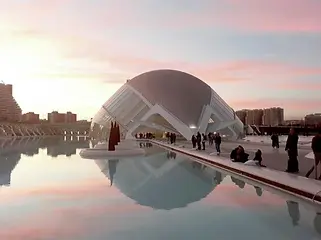
The Ciutat de les Arts i les Ciències is a must-see if you come to Valencia. Designed by Valencian architect Santiago Calatrava, it has several buildings that have become icons of the city. It is a scientific and cultural leisure complex to enjoy with family or friends that today occupies around two kilometres of the old Turia riverbed.
You will need tickets to access the Hemisfèric, the Museu de les Ciències and Oceanogràfic and you can buy them separately or together, for the buildings you are most interested in visiting.
Oceanographic
With seven different marine environments, you can see around 45,000 specimens of 500 different species, such as dolphins, belugas, sea lions, seals, penguins and sharks. Don't miss the exhibition that takes place every day at the dolphinarium. Allow at least half a day to visit it.
Hemispherical
The Hemisfèric is a 3D digital cinema with a huge 900-metre concave screen that almost envelops the audience. Several films are shown every day, most of which are educational documentaries of no more than 45 minutes, suitable for all audiences. With your ticket you will be given innovative 3D glasses with which you can also change the language of the screening. If you are travelling with children, there is usually a children's film once a day. We recommend that you check the schedule and book the screening that interests you most before beginning your visit to other buildings in the Ciutat de les Arts i les Ciències.
Museum of Sciences
With the motto “Do not touch” at this museum, you can already imagine what kind of space it is, right? The Museu de les Ciències offers various interactive exhibitions on science and technology. You can enter the ground floor without a ticket, where there is usually a temporary exhibition, some shops, toilets and a restaurant. For the rest of the exhibitions, you will need your ticket. The Museum also offers scientific workshops for all audiences for which you must buy a separate ticket.
Palace of the Arts
If you are a music lover, the Palau de les Arts is your place in the Ciutat de les Arts i les Ciències. From October to November, it offers a programme that includes operas, concerts, zarzuela, and ballet.
Umbracle
The Umbracle is a huge garden of over 17,000 m2, open to the public and is open to the public . You can stroll through it, admiring typical Mediterranean plants and contemporary sculptures. In summer and at night, the Mya terrace is open to the public, where you can enjoy a drink under the moonlight. Just below the Umbracle is the public car park of the Ciutat de les Arts i les Ciències.
Agora / CaixaForum
This Calatrava building is the headquarters of CaixaForum València, a multipurpose space that offers temporary and permanent exhibitions, live music, screenings, series of conferences and shows to enjoy culture and science.
The Golden Assault
Another of the works of the Valencian architect Santiago Calatrava, the Puente de L'Assut d'Or, crosses the old bed of the Turia River, between the Museu de les Ciències and the Ágora. There are several lanes for traffic in both directions and in the centre there is a pedestrian walkway that joins the two banks of the Turia Garden.
Bioparc Valencia, a new generation zoo
An innovative zoo where the barriers are practically invisible and the animals roam freely, it covers an area of 100,000 square metres and is located in the headwaters of the old Turia River.
This park has the peculiarity of taking the visitor completely into the habitat of the animals and not the other way around, as occurs with traditional zoos, it is the concept called zoo-immersion.
Europe's largest fresh produce market
If you are a food lover, you enjoy fresh produce, its colour, its flavour, and you value richness, variety and quality in the kitchen, the Central Market of Valencia is a paradise that you cannot miss. It is a must-see in this city, a gigantic pantry of modernist architecture, which contains all the fresh produce from the garden and all the flavour and smell of the Mediterranean inside. Don't hesitate, take a stroll through the Central Market, your senses will thank you!
Declared a World Heritage Site by UNESCO
La Lonja is one of the characteristic buildings of the city, in addition to being one of the most famous civil Gothic monuments that Europe can offer. It has enjoyed the high distinction of National Historic-Artistic Monument since June 4, 1931 and was declared by UNESCO as a World Heritage Site on December 5, 1996.
Discover the Holy Chalice and climb the Miguelete
Did you know that the Holy Chalice is in the Cathedral of Valencia? And that it also houses one of the most important paintings of the early Spanish Renaissance? And that in its Cathedral Museum you can find paintings by Maella or Goya? A climb up the Miguelete or learning about the history of the Virgen del Buen Parto are other curiosities that you should not miss.
The Valencian 'Sistine Chapel'
The church of San Nicolás de Bari and San Pedro Mártir has recently been restored, bringing to light a pictorial exhibition that experts have called the Valencian 'Sistine Chapel'. It is one of the first twelve Christian parishes in the city of Valencia after the reconquest by Jaume I in 1238.
Built as a parish church around 1242, it was renovated in Gothic style by the Borgia family between 1419 and 1455, with the Gothic ribbed vault in the central nave being contracted. Between 1690 and 1693, the interior was covered with Baroque decoration and frescoes of scenes from the life of Saint Nicholas of Bari and Saint Peter the Martyr, designed by Antonio Palomino and painted by Dionís Vidal.
National Museum of Ceramics and Sumptuary Arts González Martí (Palace of the Marquis of Dos Aguas)
In honour of the Valencian ceramics industry, the Museo Nacional de Cerámica-González Martí is located in what is considered the best example of Baroque in Spain, the Palace of the Marquis of Dos Aguas. The museum houses the largest national collection of ceramics from the 8th century to the contemporary era with pieces by Picasso.
The medieval wall of Valencia
Construction began in 1392 by Pere Balaguer. The Serranos Towers were built to defend one of the most used entrances to old Valencia. In 1865 the walls were demolished and the towers were left free. From 1586 to 1887 they were used as a prison for nobles. Later, the back of the towers was uncovered and from the Plaza de los Fueros five rooms can be seen, with pointed arches and ribbed vaults. The towers are a magnificent example of Gothic architecture.
The fortified gate of the city
Built by Pere Bonfill, based on the model of the towers of Castell Nuovo in Naples, they are an example of late Gothic military construction. Designed as defensive gates for the city, they were known as Torres de la Cal until 1874, because in the 18th century it was required that lime entering Valencia must pass through there. The rear façade was uncovered so that the interior could be seen, which for a time was used as a women's prison.
The Quart Towers were key in stopping Napoleon's troops during the War of Independence against the French in 1808. Even today, the marks of the cannon shots can be seen on their towers.
The tour that ends the most epic search
You can't leave Valencia without seeing its most precious treasure: the Holy Grail. The relic that the Church recognises as the Chalice that was in the hands of Jesus Christ at the Last Supper, through the granting of the Jubilee Year. Discover how it ended up in the Valencian Cathedral, listen to the fascinating stories of the Knights Templar who searched for it and many others who coveted it, and admire the works of local artists who were inspired by it. A tour in which you will find everything you were looking for.